MitraSETI
Rust-Accelerated Radio Signal Analysis with ML Classification
v0.2.0 — Released
Rust-Accelerated Radio Signal Analysis with ML Classification
v0.2.0 — Released
Demo
Real-time signal processing, ML classification, and interactive visualization.
Architecture
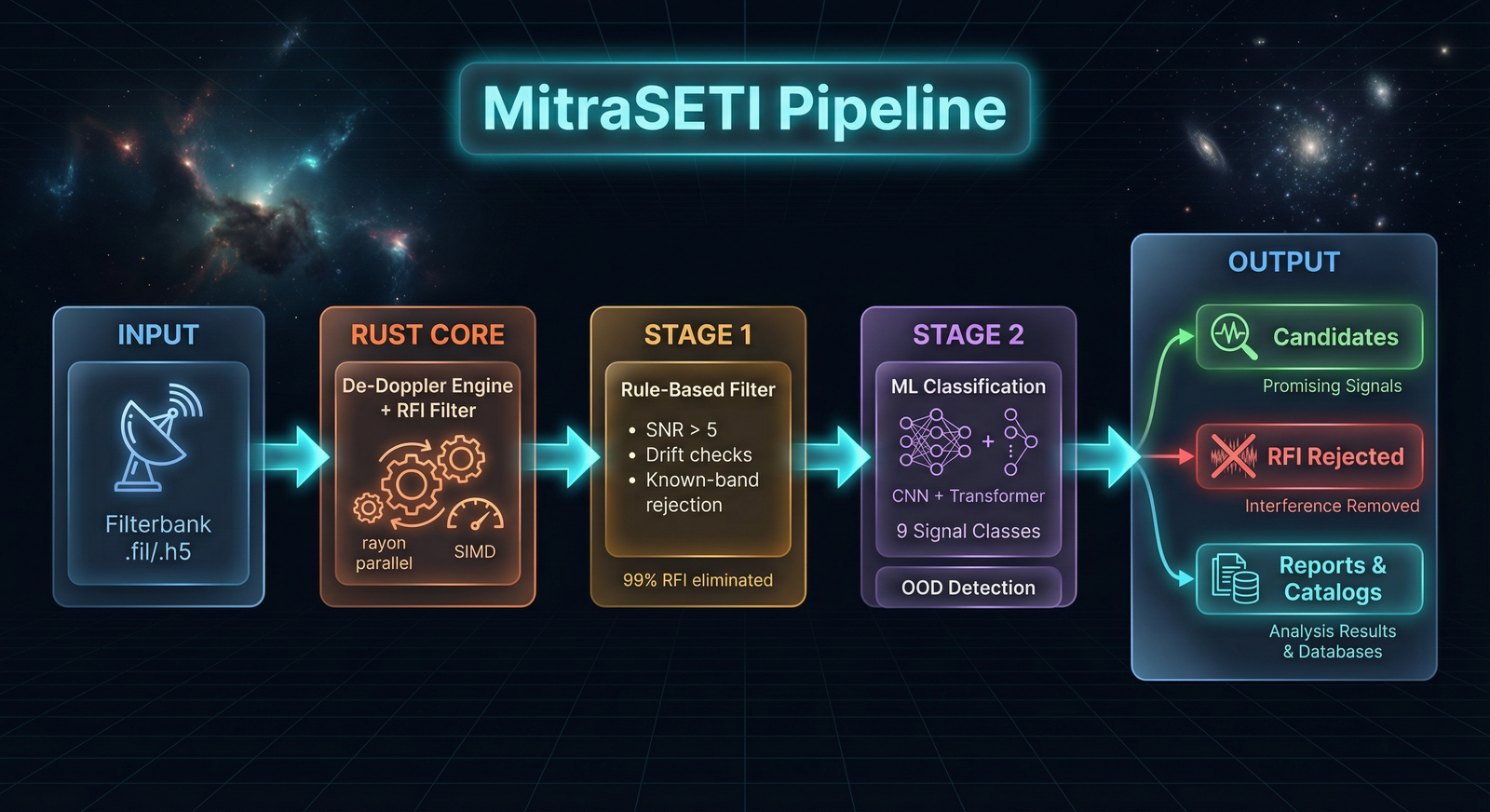
From raw Breakthrough Listen filterbank data to ML-classified candidates — fully automated, self-correcting, and 45x faster than the standard.
Benchmark
Measured on real Breakthrough Listen observation data. No synthetic files, no cherry-picked runs.
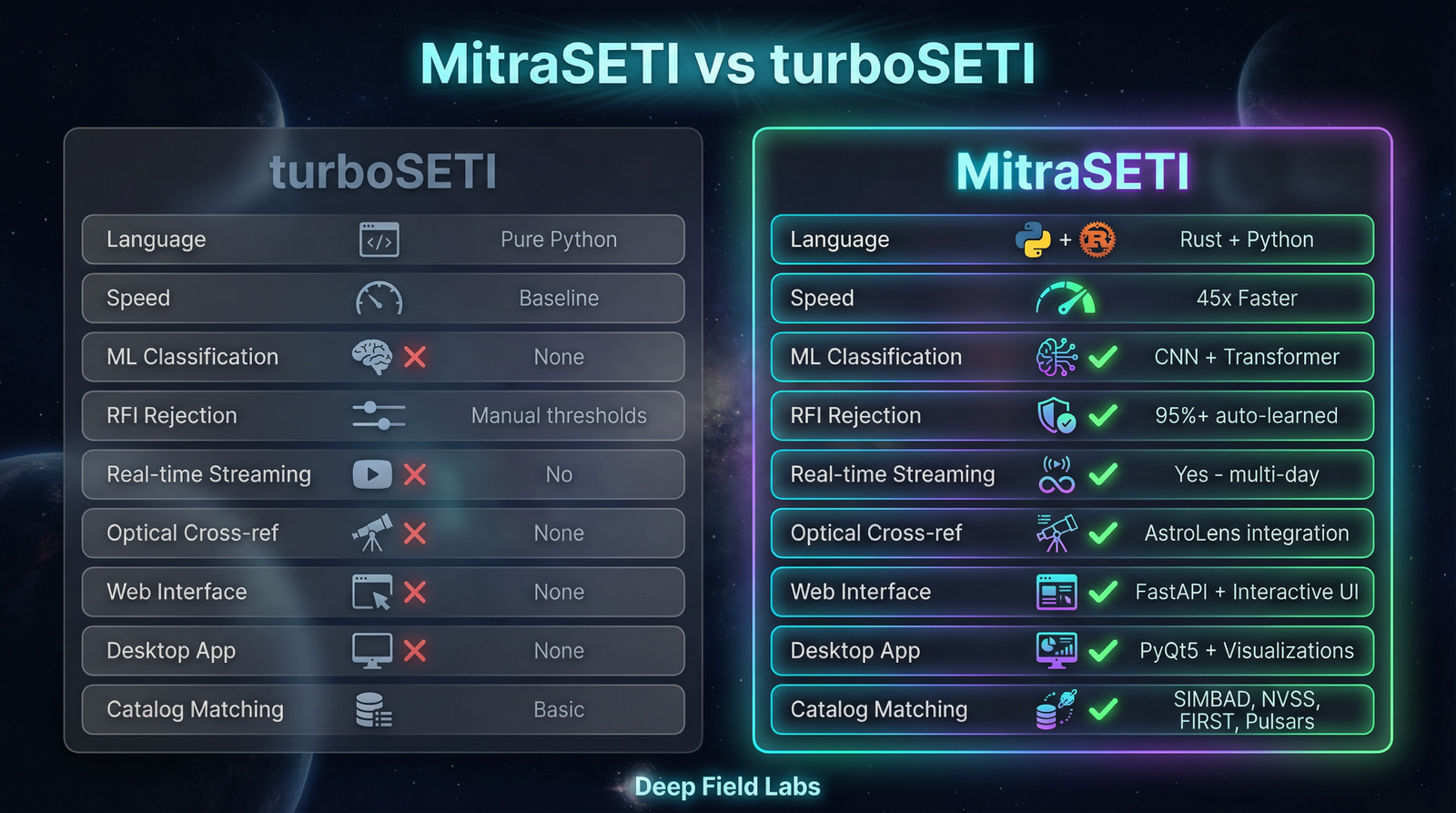
45x speedup on Voyager-1 data. MitraSETI processes a million-channel HDF5 observation in 0.06 seconds — turboSETI takes 2.53 seconds for the same file. The Rust de-Doppler engine distributes drift-rate trials across all CPU cores using rayon parallelism, replacing turboSETI's single-threaded Python loop.
v0.2.0 introduces the Taylor tree algorithm — an O(N log N) de-Doppler search that achieves 4.3x additional speedup over brute-force on Voyager-1 data. Combined with HDBSCAN density-based clustering and adaptive spectral kurtosis RFI excision, the pipeline now processes real Breakthrough Listen data with publication-grade sensitivity.
turboSETI reports raw hits. MitraSETI reports classified candidates — signals that survived rule-based filtering, CNN+Transformer inference, and out-of-distribution analysis. One high-confidence candidate is more actionable than three unscreened hits.
Results
Autonomous analysis across 2,200 Breakthrough Listen observations with full ML pipeline.
Desktop Application
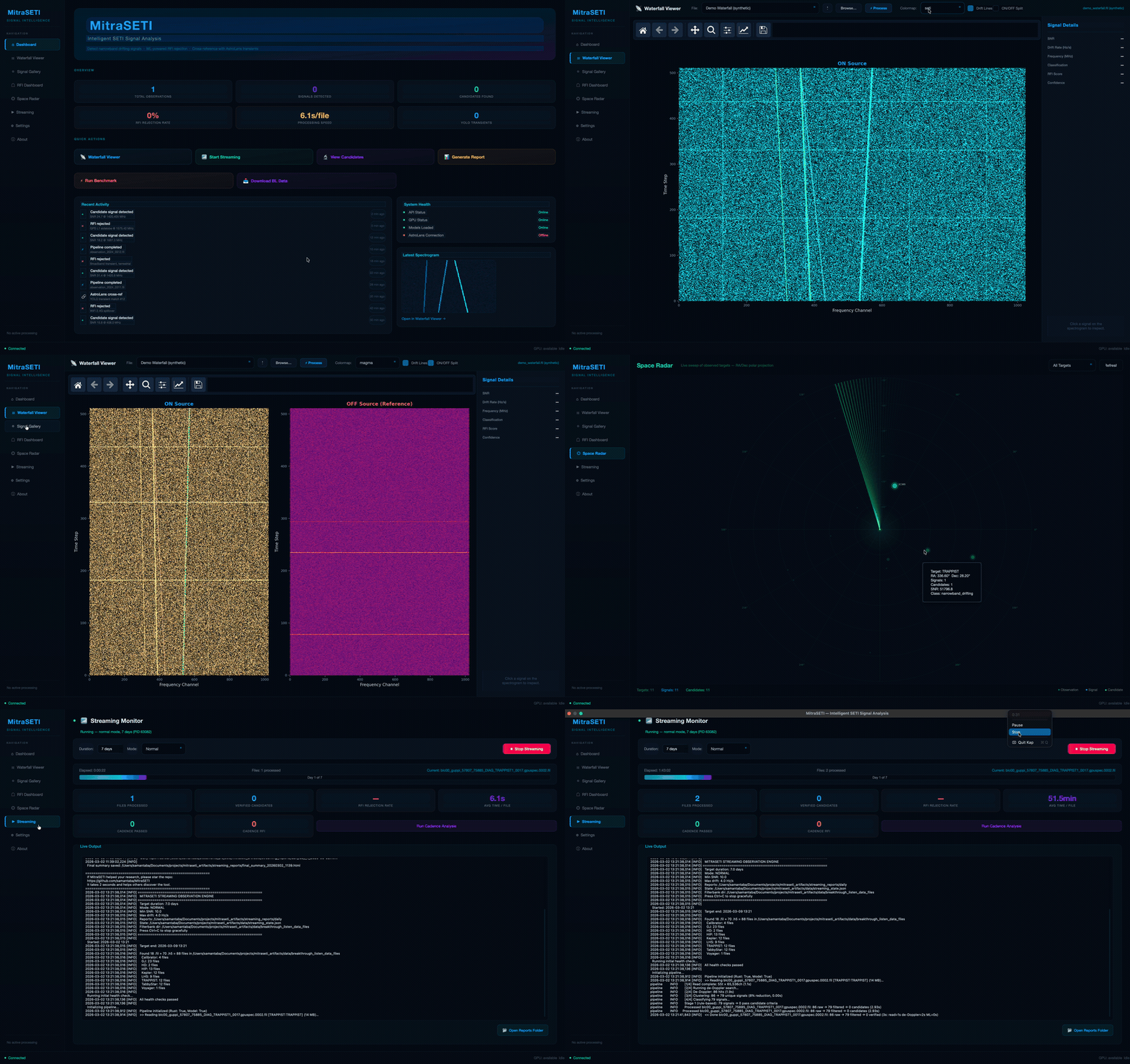
MitraSETI ships with a full-featured PyQt5 desktop app and a FastAPI web interface for real-time signal monitoring.
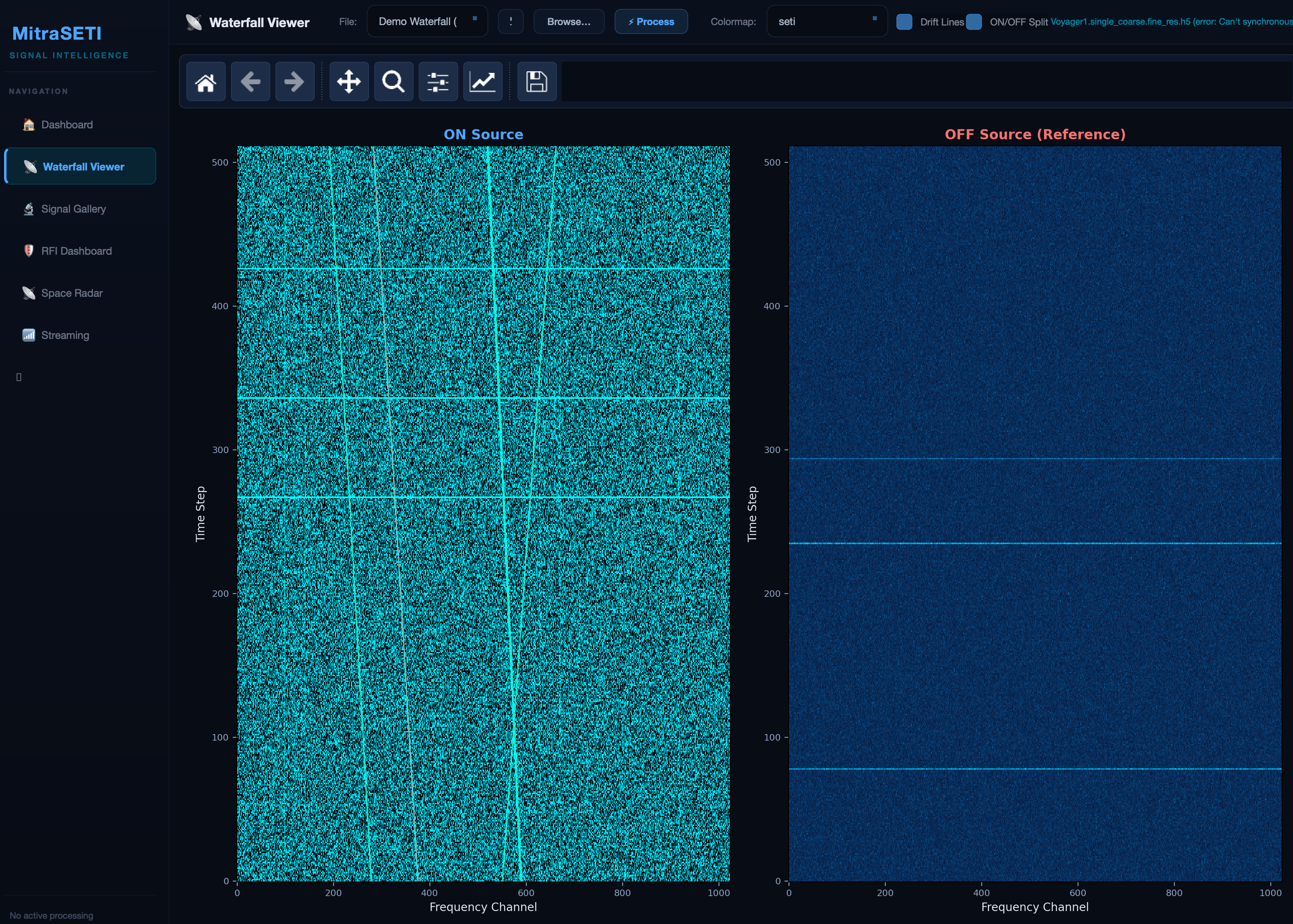
Waterfall Viewer — spectrogram display with drift-rate overlay and zoom controls
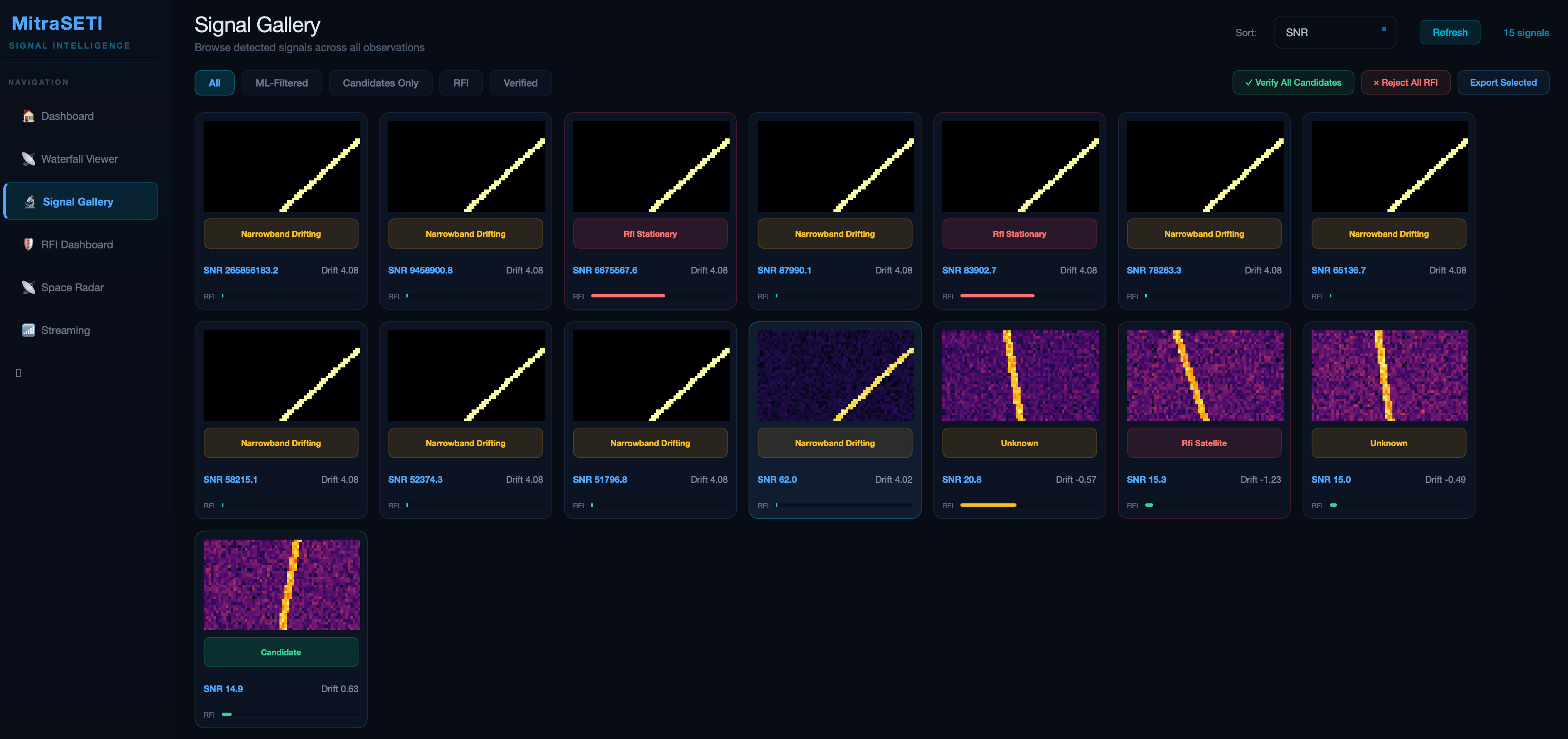
Signal Gallery — ML-classified detections with confidence scores
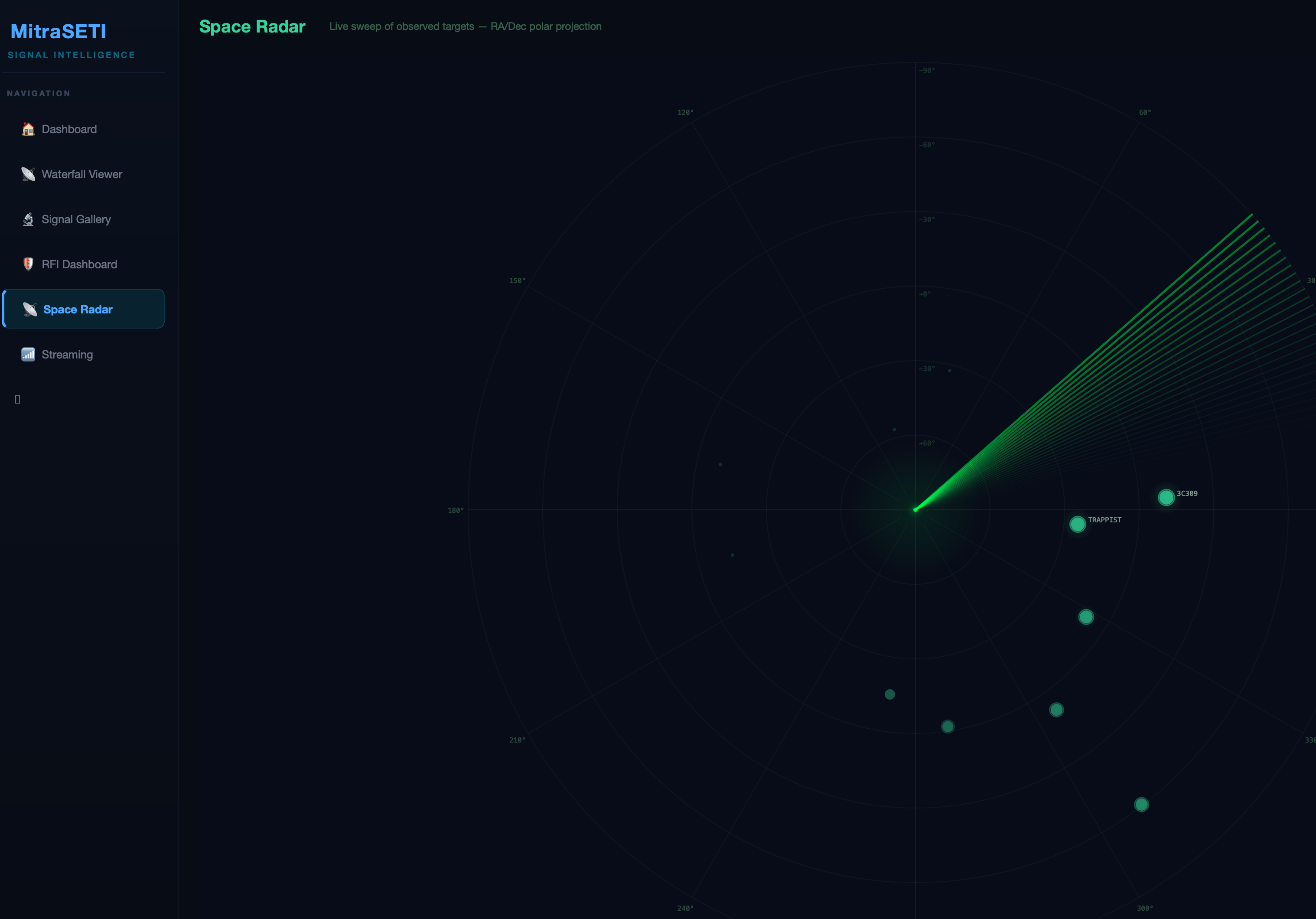
Sky Radar — interactive celestial map with radio + optical overlay
Technology
A hybrid Rust+Python architecture. Rust handles the compute-intensive DSP. Python handles ML inference and orchestration.
Hybrid Rust+Python architecture. Rust handles DSP, Python handles ML inference.
What's New
13 major features for scientifically rigorous radio signal analysis, built for reproducibility and interoperability.
O(N log N) algorithm — 4.3x faster than brute-force on Voyager-1. Based on Taylor (1974).
Density-based hit deduplication replaces greedy method for robust false-positive reduction.
Adaptive thresholds (median + MAD) for RFI excision. Nita & Gary (2010) method.
Standard astronomical format via astropy. Compatible with TOPCAT, Aladin, and VO tools.
27 cataloged terrestrial interference sources for automated labeling (GPS, Iridium, WiFi, etc.).
Track recurring signals across multiple observations of the same target for credibility scoring.
SkyCoord KD-tree matching between MitraSETI radio detections and AstroLens optical anomalies.
mitraseti search, stream, benchmark, export, crossmatch, report.
Standard RFI rejection using observation cadence patterns (ABACAD).
Infrastructure
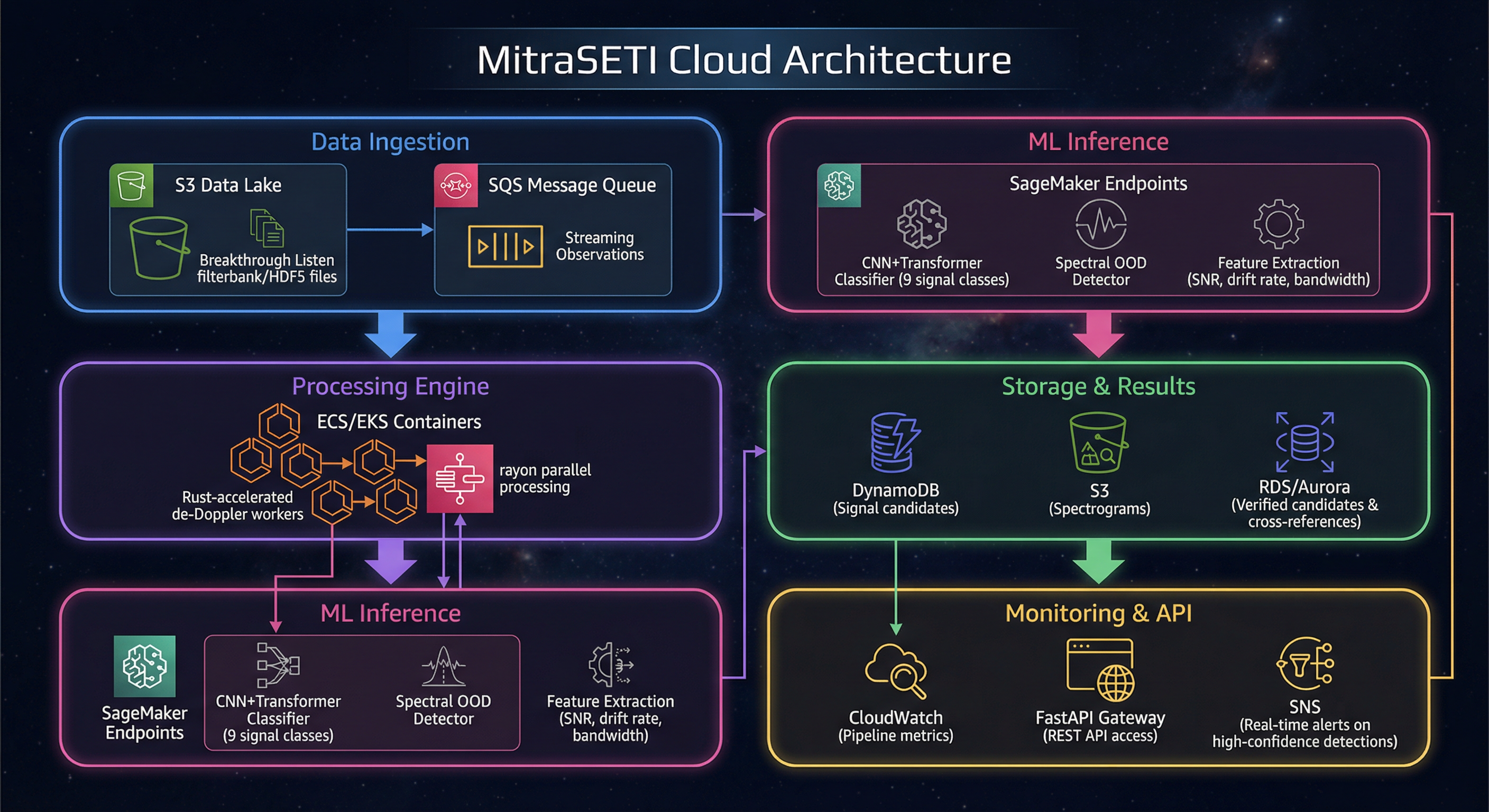
Production deployment on AWS — from Breakthrough Listen data ingestion to ML-classified candidates at scale.
Now Live
MitraSETI Cloud is a fully managed SaaS platform for radio astronomy signal analysis. Upload your observation data, run automated detection and ML classification pipelines, and visualise results — all in your browser. No infrastructure setup required.
Upload .h5, .fil, .fits, and .hdf5 files up to 1 GB. Automated pipelines handle the rest.
AstroLens-powered CNN + Transformer models classify signals and flag anomalies automatically.
Waterfall plots, signal galleries, and pipeline monitoring — real-time in your browser.
Free tier available • No credit card required • Researcher and Institution tiers for larger workloads
Open Source
MitraSETI is open-source under the MIT License. Contributions, feedback, and collaboration welcome.
View MitraSETI on GitHub