Open-Source AI for
Astronomical Discovery

We build intelligent tools that scan the sky, detect anomalies, and surface discoveries -- autonomously, at scale.

Local-first. Cloud-ready. Built for researchers and production.

What We Build

Intelligent tools for automated astronomical discovery, from optical image analysis to radio signal processing.

AstroLens

v1.1.0

Released

AI-powered astronomical image anomaly detection

  • Vision Transformer + YOLO transient detection
  • Autonomous multi-day streaming discovery
  • Self-correcting intelligence with 99.5% accuracy
  • Cross-references against SIMBAD astronomical database
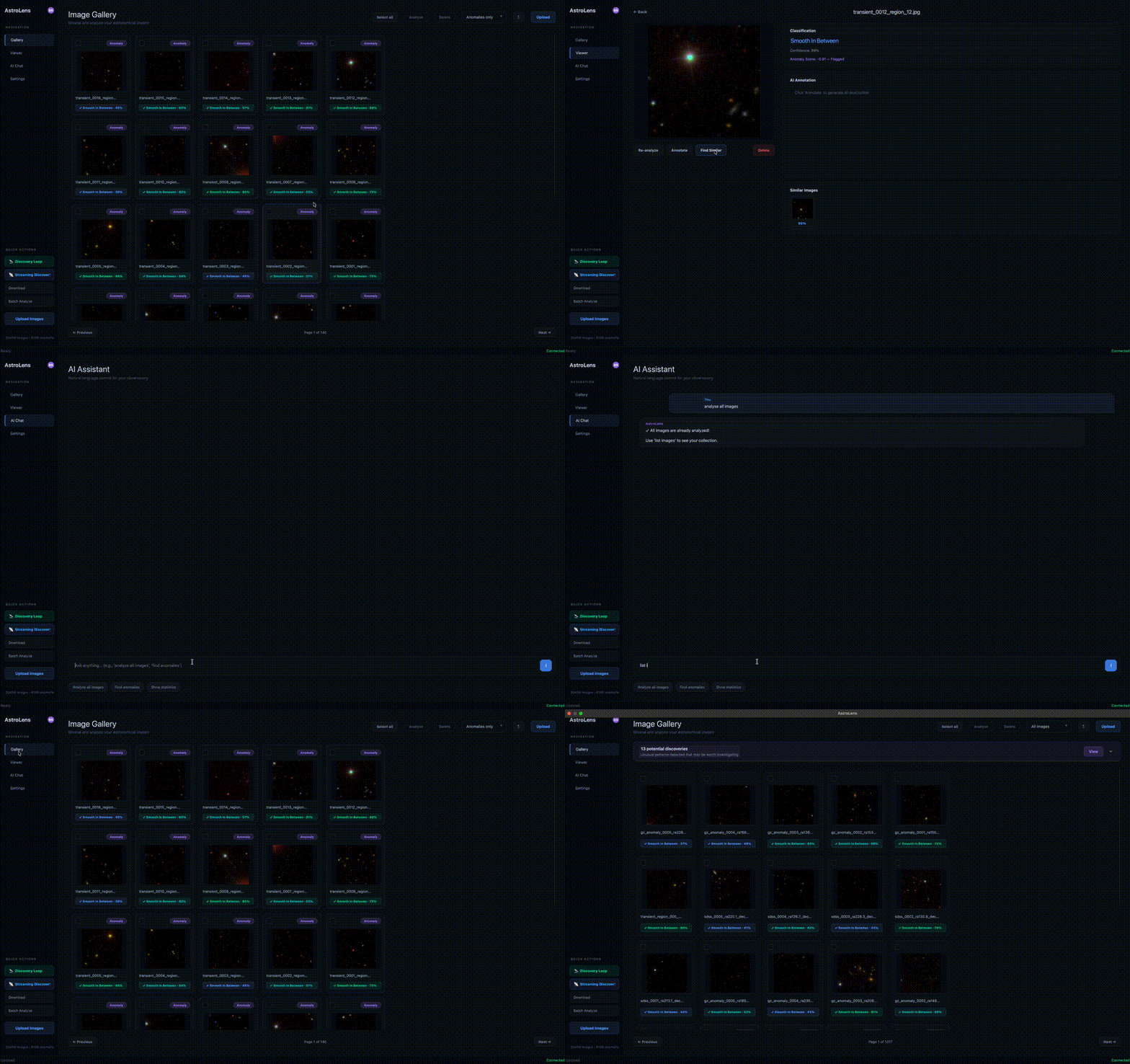
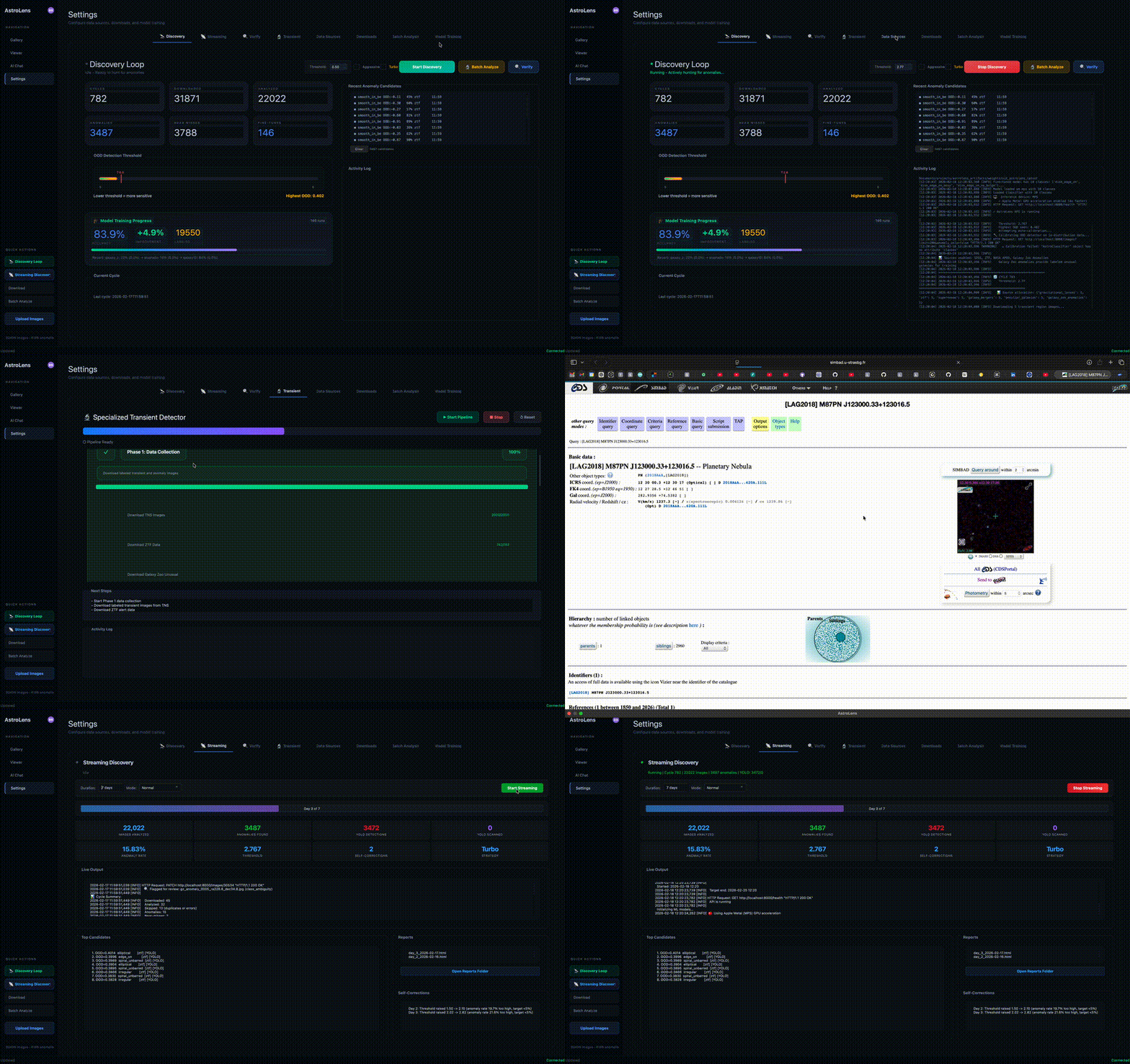
AstroLens anomaly detection demo
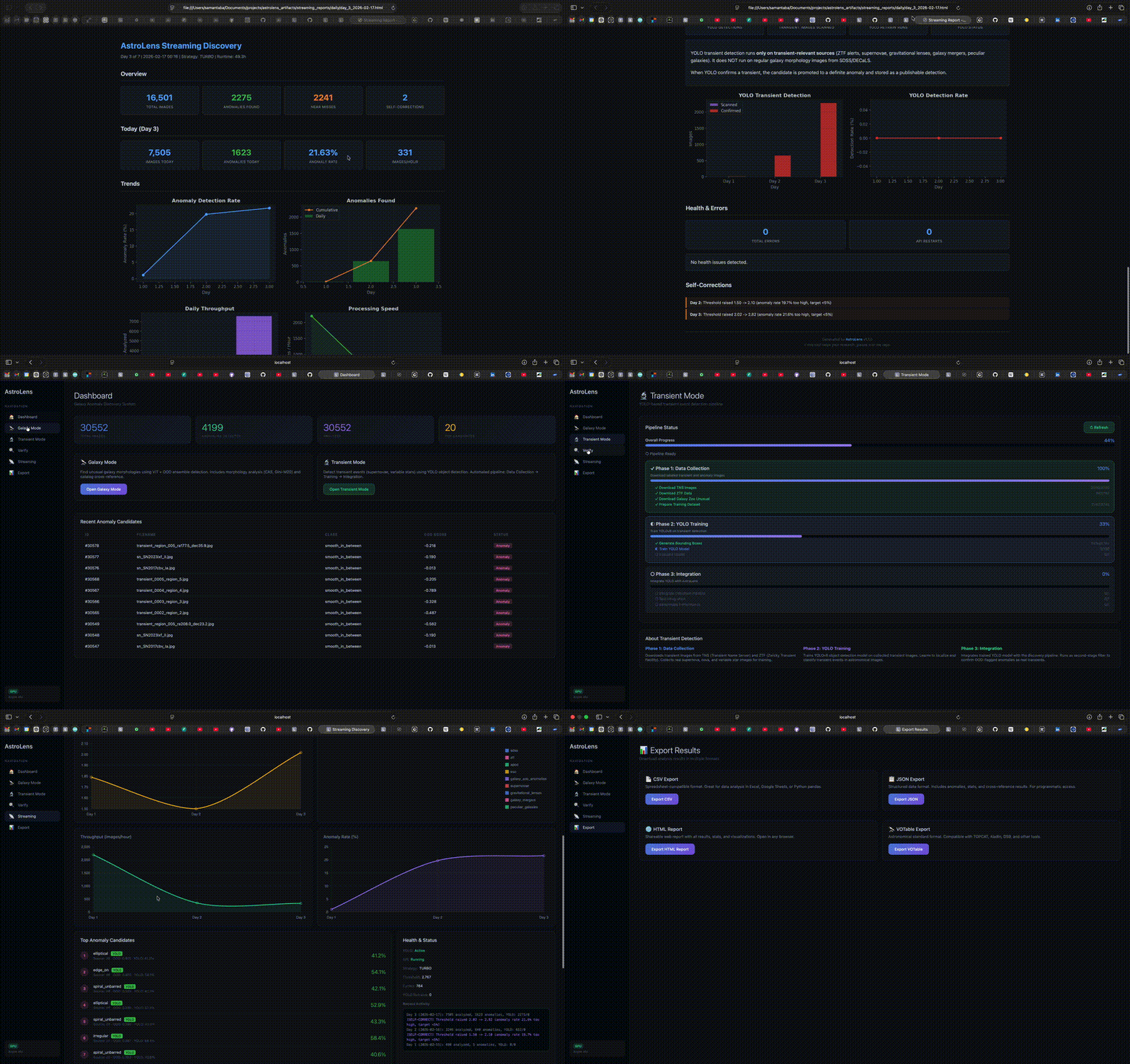
Validated: 22,195 images analyzed, 3,541 anomaly candidates, 269 known objects independently recovered
View on GitHub

AstroSETI

v0.1

In Development

High-performance radio signal anomaly detection

  • Rust-accelerated parallel de-Doppler search
  • ML-based RFI filtering
  • CNN + Transformer signal classification
  • Optical-radio cross-reference (integrates with AstroLens)
Designed to process filterbank data 10-50x faster than existing tools
View on GitHub

Why We Built This

Modern astronomical surveys generate 20 terabytes of data per night. The next generation of telescopes (LSST/Rubin Observatory) will produce even more. The bottleneck in astronomy has shifted from collecting observations to analysing them. Most survey images are classified once by a standard pipeline and never examined again. Unusual objects — galaxy mergers, transient events, gravitational lenses — slip through unnoticed.

We built AstroLens and AstroSETI because this problem is solvable with modern ML engineering. An ensemble of specialised models (Vision Transformers for classification, out-of-distribution detection for anomalies, YOLO for transient localisation) can systematically screen every image and flag what deserves a second look — without human fatigue, bias, or time constraints.

These tools demonstrate what we deliver professionally: end-to-end ML systems that move from a research concept to a production-grade, self-operating pipeline. The same engineering approach — designing for autonomy, building self-correcting feedback loops, instrumenting for observability — applies to any domain where organisations need to extract signal from large-scale data streams.

Capability

Autonomous anomaly detection that runs for days with zero intervention, self-corrects, and improves its own models during operation.

Credibility

Validated against real astronomical data. Independently recovered known published objects (supernovae, galaxy mergers, gravitational lenses) without prior knowledge.

Transferable

The architecture patterns — streaming ML pipelines, self-correcting thresholds, autonomous operation — apply to any domain that processes high-volume data at scale.

What AstroLens Found

Autonomous analysis across multiple sky surveys with zero human intervention.

AstroLens gallery and viewer demo
22,195
Images Analyzed
3,541
Anomaly Candidates
99.5%
YOLO Detection Accuracy
5,471
Unique Sky Regions
0
Human Intervention Required
269
Known Objects Recovered
Including SN 2014J, NGC 3690, SDSS J0252+0039

How It Works

An end-to-end intelligent pipeline from raw sky survey data to actionable discovery reports.

AstroLens web visualization demo
Download from Sky Surveys
ViT Classification
OOD Anomaly Detection
YOLO Transient Detection
Catalog Cross-Reference
Discovery Report
Python PyTorch FastAPI YOLOv8 Docker

Runs on laptop: CPU, Apple MPS, and NVIDIA CUDA supported

From Research to Production on AWS

Universal solution patterns that take ML and AI workloads from local research environments into production-ready cloud deployments.

Local ML/AI Baseline

Current open-source tools run locally on any laptop. This is the research and experimentation layer.

Vision Transformer + OOD ensemble for anomaly detection
YOLOv8 for transient localization and tracking
Self-correcting streaming pipeline for autonomous operation
Cross-platform desktop app (Qt/PyQt5), web UI, CLI, Docker containers
GPU acceleration (CUDA, Apple MPS) with CPU fallback

AWS Cloud Architecture

Production deployment on AWS. Managed services orchestrate the full ML pipeline at scale.

Amazon SageMaker
Model training, fine-tuning, and managed inference endpoints
AWS Step Functions
Orchestration of multi-stage ML pipelines (download, classify, detect, cross-reference, report)
Amazon Bedrock
Foundation model integration for enhanced classification and natural language analysis of findings
Amazon S3
Data lake for survey images, model artifacts, and results
Amazon SQS / SNS
Event-driven processing and alert notifications
AWS Lambda
Serverless preprocessing, image validation, and lightweight inference
Amazon DynamoDB
Low-latency metadata store for candidates and cross-reference results
Amazon CloudWatch
Monitoring, alerting, and pipeline health dashboards
Amazon ECR + ECS/EKS
Container orchestration for scalable inference workers
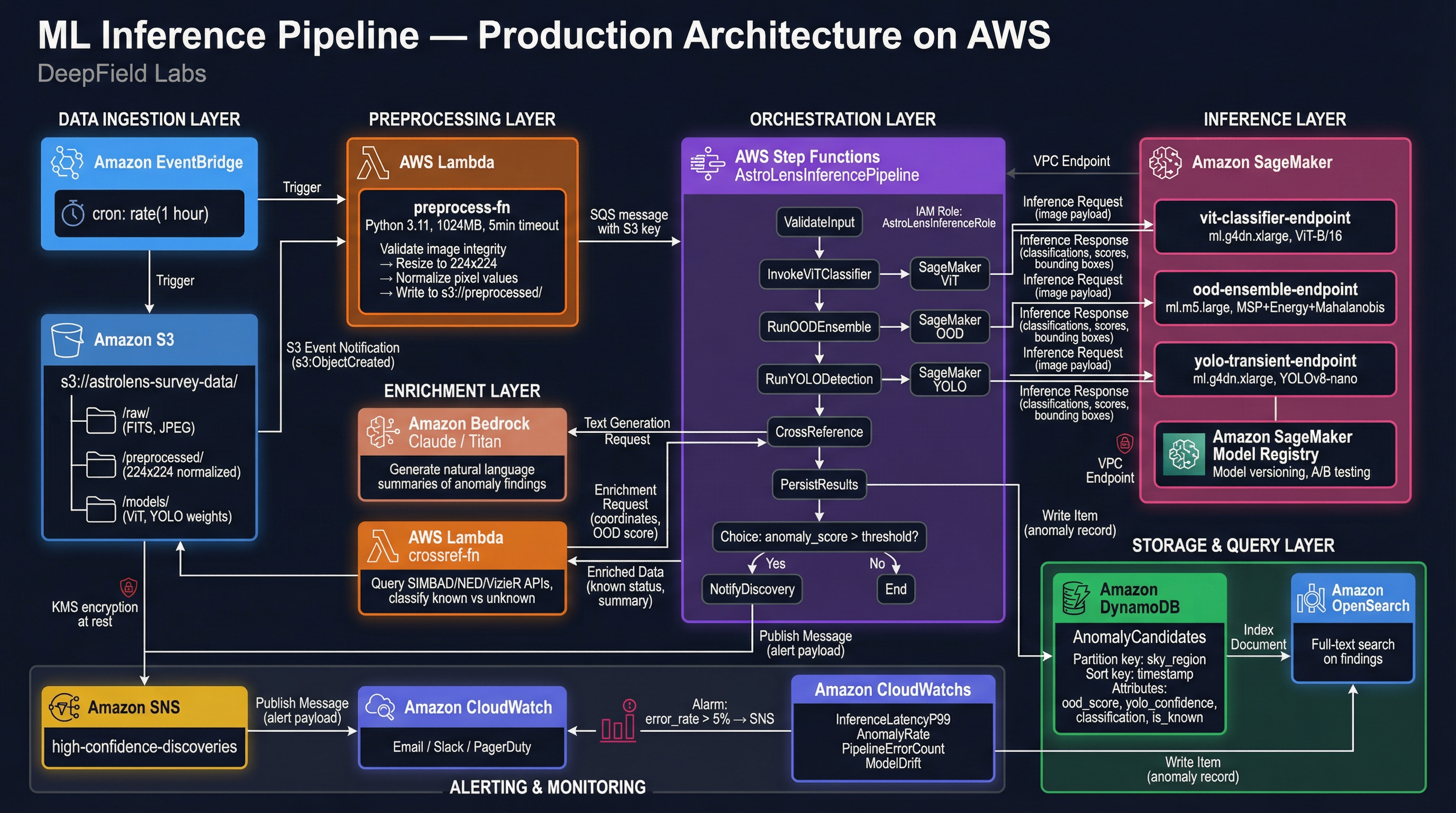
ML Inference Pipeline - AWS Production Architecture

Data Flow: Inputs, Processing, Outputs

Inputs
  • Sky survey image archives (SDSS, ZTF, DECaLS)
  • Transient alert streams (TNS, ZTF alerts)
  • Astronomical catalog data (SIMBAD, NED)
  • Pre-trained model artifacts (ViT, YOLO)
Processing
  • Step Functions orchestrates multi-stage pipeline
  • Lambda validates and preprocesses images
  • SageMaker runs ViT + OOD + YOLO inference
  • Bedrock provides enhanced analysis context
  • Cross-reference against catalog databases
Outputs
  • Ranked anomaly candidates with confidence
  • Cross-reference verification status
  • Morphology and classification reports
  • Real-time SNS alerts for high-confidence detections
  • CloudWatch dashboards and operational metrics

DevOps & Platform Engineering

End-to-end delivery covering design, implementation, automation, and operations. Full lifecycle ownership from solution architecture through to production reliability.

Infrastructure as Code

Terraform, CloudFormation, CDK -- repeatable, version-controlled infrastructure

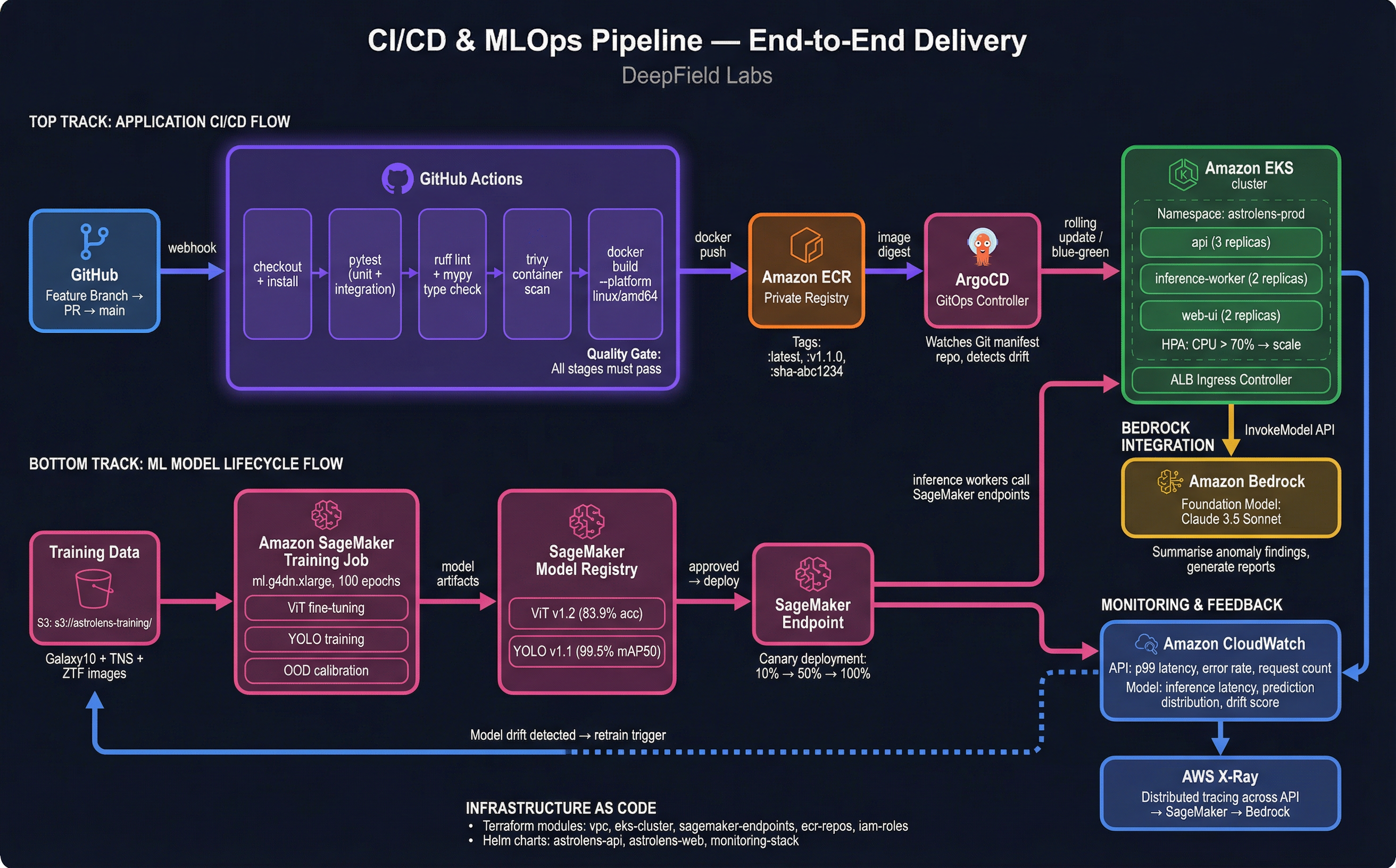
CI/CD Pipelines

GitHub Actions, CodePipeline -- automated build, test, and blue-green deployment to ECS/EKS

GitOps & ArgoCD

Declarative deployments, drift detection, and rollback from a single source of truth

Container Orchestration

ECS and EKS workload management, auto-scaling, service mesh, multi-AZ resilience

Security & Compliance

IAM policies, GuardDuty, Security Hub, automated vulnerability scanning in pipeline

Observability

CloudWatch, X-Ray, Prometheus, Grafana -- full-stack monitoring and distributed tracing

Cost Optimisation

Right-sizing, Savings Plans, Spot instances, Cost Explorer dashboards

CI/CD and Deployment Pipeline
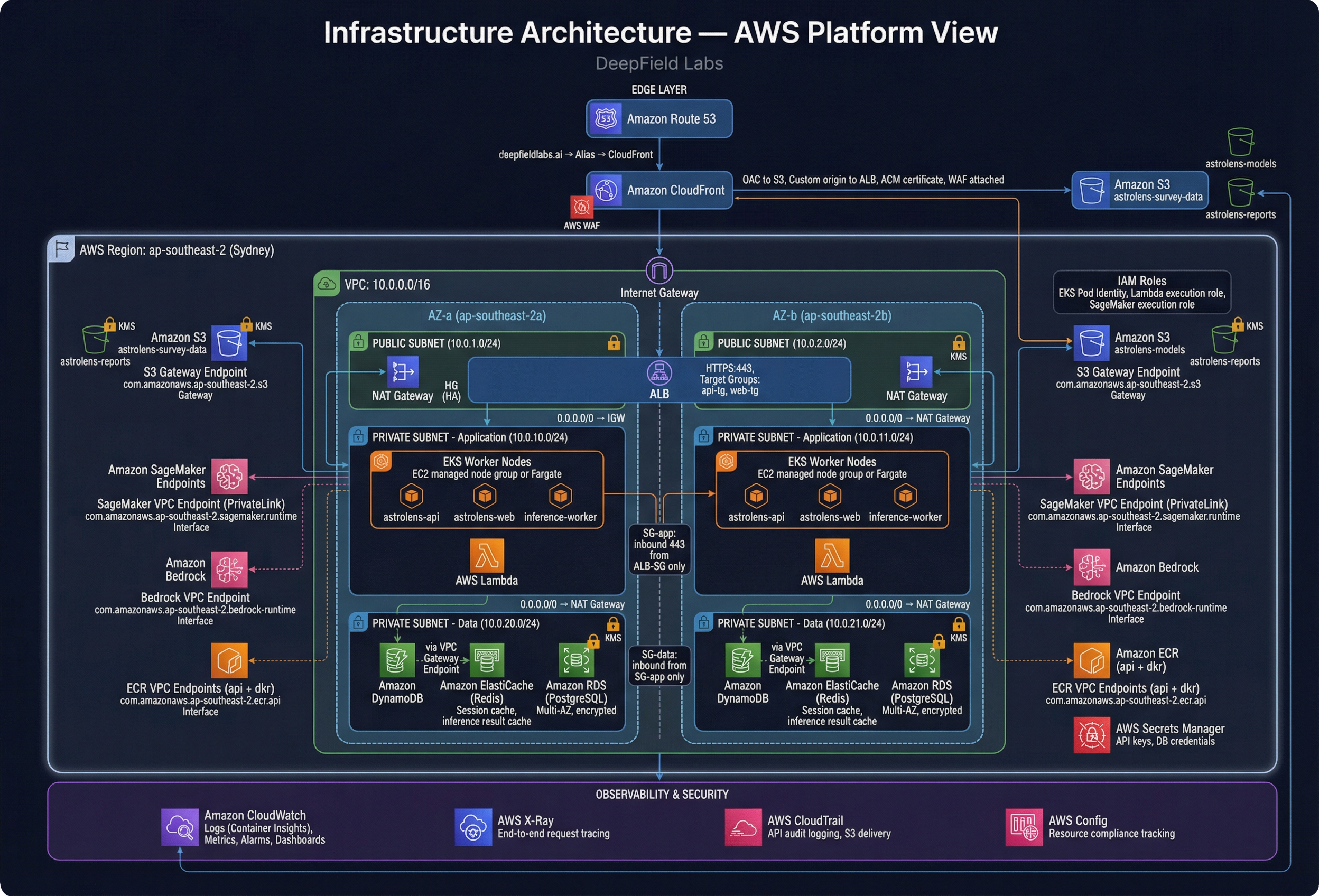
Infrastructure Architecture - AWS Platform View

Who We Are

Saman Tabatabaeian

Saman Tabatabaeian

Technical Director -- Cloud, DevOps & Platform Engineering

Saman is a specialist in AWS Cloud and DevOps with 10+ years of experience delivering cloud platform consultancy and production-grade solutions for large organisations. He designs and automates secure, scalable AWS architectures end-to-end—covering solution design, CI/CD, platform engineering, and technical leadership—with a focus on building reusable patterns that teams can ship, operate, and evolve with confidence.

Before specialising in cloud, Saman built a strong software engineering foundation across Linux embedded systems, monitoring applications, and cross-platform desktop development using Qt, including low-level networking and protocol implementation in C. That mix of deep engineering roots and modern AWS delivery means he brings practical judgement to every engagement—balancing speed, reliability, security, and cost without the hype.

AWS Solutions Architect AWS Data Analytics AWS Security Cloud Architecture DevOps & Platform Engineering Technical Leadership ML/AI Infrastructure Python Qt / Cross-Platform UI Docker & Kubernetes CI/CD Automation Infrastructure as Code Serverless & Microservices Embedded Systems
Why Open Source

Science advances fastest when tools are open, reproducible, and accessible to everyone.

Transparent Research

Transparent and reproducible research that anyone can verify, audit, and build upon.

Local-First Execution

No cloud dependency required. Run everything on your own hardware, with your own data.

Easy Integration

Designed to plug into existing research pipelines with standard interfaces and formats.

Community Driven

Community-driven development and improvement. Contributions, feedback, and collaboration welcome.

Let's Work Together

Open to research collaborations, industry partnerships, and commercial engagements.

Research Collaboration

Partner on astronomical surveys, anomaly detection research, or radio signal analysis projects.

Commercial Deployment

Deploy AI-powered astronomical analysis at scale with cloud-native architecture and support.

Custom Development

Custom ML pipelines, data processing systems, and infrastructure tailored to your research needs.